Lies and Credibility
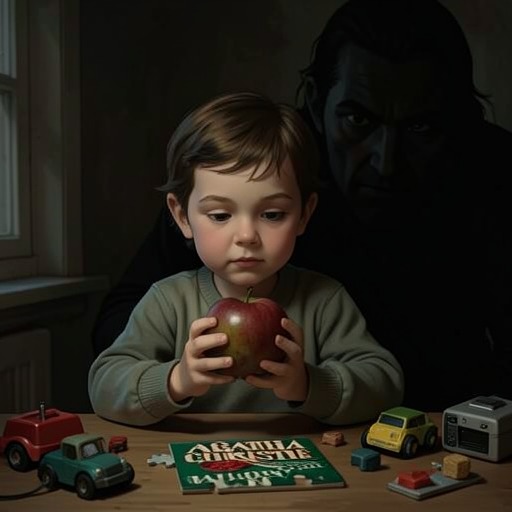
Hallowe'en PartyLies and Credibility names a central tension in the novel: the distinction between whether a witness is telling the truth and whether other people are prepared to believe her. Joyce Reynolds’s habitual boasting makes her report of a murder easy to dismiss, but the later emergence of Miranda Butler’s memory gives that dismissed claim a startling basis. The novel treats credibility not as a simple quality that a speaker possesses, but as a judgment made by listeners—and one that can fail precisely when belief matters most.
Reputation and the First Dismissal
At the party, Joyce says that she once saw someone commit a murder. The claim comes out during a conversation about writing murder stories, and it is met not with careful questions but with laughter and rebuke. Her mother or another adult tells her not to be silly; an older girl says she is making it up. Joyce insists that she saw it, grows angry as the others laugh, and offers no names or particulars. When pressed about why she never went to the police, she explains that she did not recognize the event as a murder until later, when the understanding came to her suddenly. She says it happened years before and that she had forgotten it.
Those circumstances make the claim difficult to assess. Joyce supplies no identifying details that the listeners can test, and her own account involves a long gap between seeing the event and understanding what it meant. Yet the group’s response is shaped at least as much by its view of Joyce as by those weaknesses in the story. Her insistence and anger are read as further signs of performance rather than as reasons to investigate. The question of credibility is therefore already entangled with social embarrassment: the company treats Joyce’s claim as a bid for attention before establishing whether it is true.
A Reputation That Weakens Testimony
Elspeth McKay describes Joyce as a natural liar, someone who can tell an impressive tall tale well. Her assessment rests on a broader pattern: Joyce has told a travel story about a trip she never took, and Elspeth consequently expects her other extravagant claims to be false. She does not describe Joyce as lying chiefly to escape punishment or conceal a small misdeed. Rather, Joyce boasts about things that have not happened because they might impress the friends listening to her. That distinction explains how a reputation can become persuasive: repeated fabrication gives listeners a reason to discount later testimony, even when the later claim concerns something real.
Superintendent Spence resists treating that pattern as proof about every story Joyce told. A false travel tale, he argues, cannot establish that all her tall tales were false. Elspeth acknowledges the possibility, but still judges that Joyce was probably lying about the murder. Her position is neither complete certainty nor full openness: she thinks Joyce most likely invented the account, while allowing that she may have seen something, if not everything she claimed to see. The disagreement exposes the gap between probability and knowledge. A reputation may rationally affect how a story is weighed, but it cannot settle the truth of a particular story in advance.
The Wolf Story and the Cost of Disbelief
Elspeth compares Joyce to the boy in The Boy Who Cried Wolf: a person who cries out falsely so often that others fail to respond when the danger is real. The comparison captures the danger of a damaged reputation, but it also makes the listeners’ responsibility visible. Joyce’s earlier inventions help explain why her companions laugh; they do not guarantee that the murder claim is another invention. The story’s familiar moral thus cuts in two directions. It warns against habitual lying, while also warning an audience that habitual falsehood can train it to ignore a true alarm.
After Joyce is found murdered, Superintendent Spence turns that abstract risk into a pointed reminder: she got herself killed. Elspeth accepts that this fact may mean she misjudged Joyce and says she is sorry if she did. Her response does not erase her prior assessment, nor does it make her claim that Joyce was usually truthful. Instead, her certainty becomes less secure once the cost of dismissing the possibility is no longer hypothetical. Joyce’s death changes the moral weight of the group’s earlier laughter: what had seemed like harmless teasing now sits beside a potentially true report that no one took seriously.
Reassessment Through Ariadne Oliver
Ariadne Oliver also initially doubts Joyce. She thinks the girl may be vaguely remembering something she once saw and building it up to make it sound important and exciting. Joyce’s emphatic repetition—that she did see it happen—does not at first persuade her. Only after finding Joyce dead does Ariadne feel that the claim might have been true. Hercule Poirot makes this shift explicit by asking her to distinguish between Joyce having really witnessed a murder and Joyce merely believing that she had. The question insists on a distinction ordinary conversation had blurred: a speaker can be sincere without being accurate, but suspicion about a speaker’s habits is not itself proof that her memory is false.
Ariadne’s changed response is not presented as confirmation based on Joyce’s forcefulness alone. It follows the discovery of Joyce’s death and the recognition that the claim could matter to an inquiry. The sequence turns credibility into a problem of timing: the same words that once sounded like an attention-seeking boast acquire a different urgency after the speaker can no longer explain them. Listening carefully would not automatically have supplied the missing names or solved the crime, but dismissing the story meant that its possible evidentiary value was left unexplored.
Miranda’s Memory and the Return of Evidence
The novel eventually gives this problem a concrete counterpart in Miranda Butler. When Alfred Richmond questions her, Hercule Poirot establishes that she had seen something over a year earlier, nearer two years, and had mentioned it to only one person. Miranda identifies that person as Joyce. Her account shows why a child’s experience may not arrive as a clear, immediately credible report: what she saw had to be remembered and understood before she could recognize it as a murder.
Miranda recalls watching from behind bushes while two people sat talking about a Greek island. A green woodpecker appears in the recalled scene; when it flies away and Miranda moves, one of the people says that somebody is watching them. The words and expression bring the earlier experience back to her as though it were happening again. This time she understands what the blood, the knife, and the limp dead body meant: she had seen a murder and the removal of a body to conceal it. Her account does not simply repeat Joyce’s claim; it supplies the kind of remembered circumstance that Joyce’s own party story lacked.
The contrast between the two girls sharpens the novel’s concern with testimony. Joyce is disbelieved because her history encourages people to treat her as a performer; Miranda has information but does not immediately possess an adult understanding of what she witnessed. Joyce’s willingness to listen to Miranda matters within that chain: Miranda says she told Joyce alone. The resulting structure separates having seen an event, understanding it, telling someone, and being believed. By the time Miranda can recount what she knows to the Chief Constable, the reader can see how easily each step might have failed. Credibility, in this account, is not merely a verdict on character; it is part of the route by which concealed evidence becomes speakable.